

Artificial intelligence has moved past the hype cycle. It's no longer a question of whether your business should use AI — it's a question of where it actually pays off. And that's where most companies get it wrong: they either chase every shiny tool on the market, or they freeze and do nothing while competitors quietly automate their way ahead.
At Ravan Studio, we believe in strategy before execution — and AI is no exception. This guide breaks down the practical, proven ways businesses of any size can put AI to work: cutting costs, winning customers, and making smarter decisions, without burning budget on tools you don't need.
What “Using AI in Business” Actually Means
When people say “AI,” they usually mean one of three things:
• Machine learning (ML) — systems that find patterns in your data (sales trends, churn risk, inventory demand) and get better over time.
• Generative AI — tools like large language models that create content: emails, product descriptions, code, images, and first drafts of almost anything.
• Automation with intelligence — workflows that don't just follow rules, but adapt: routing support tickets, scoring leads, flagging anomalies.
The businesses that benefit most don't “adopt AI.” They identify a specific bottleneck — slow customer response times, manual data entry, guesswork marketing — and apply the right kind of AI to that one problem first.
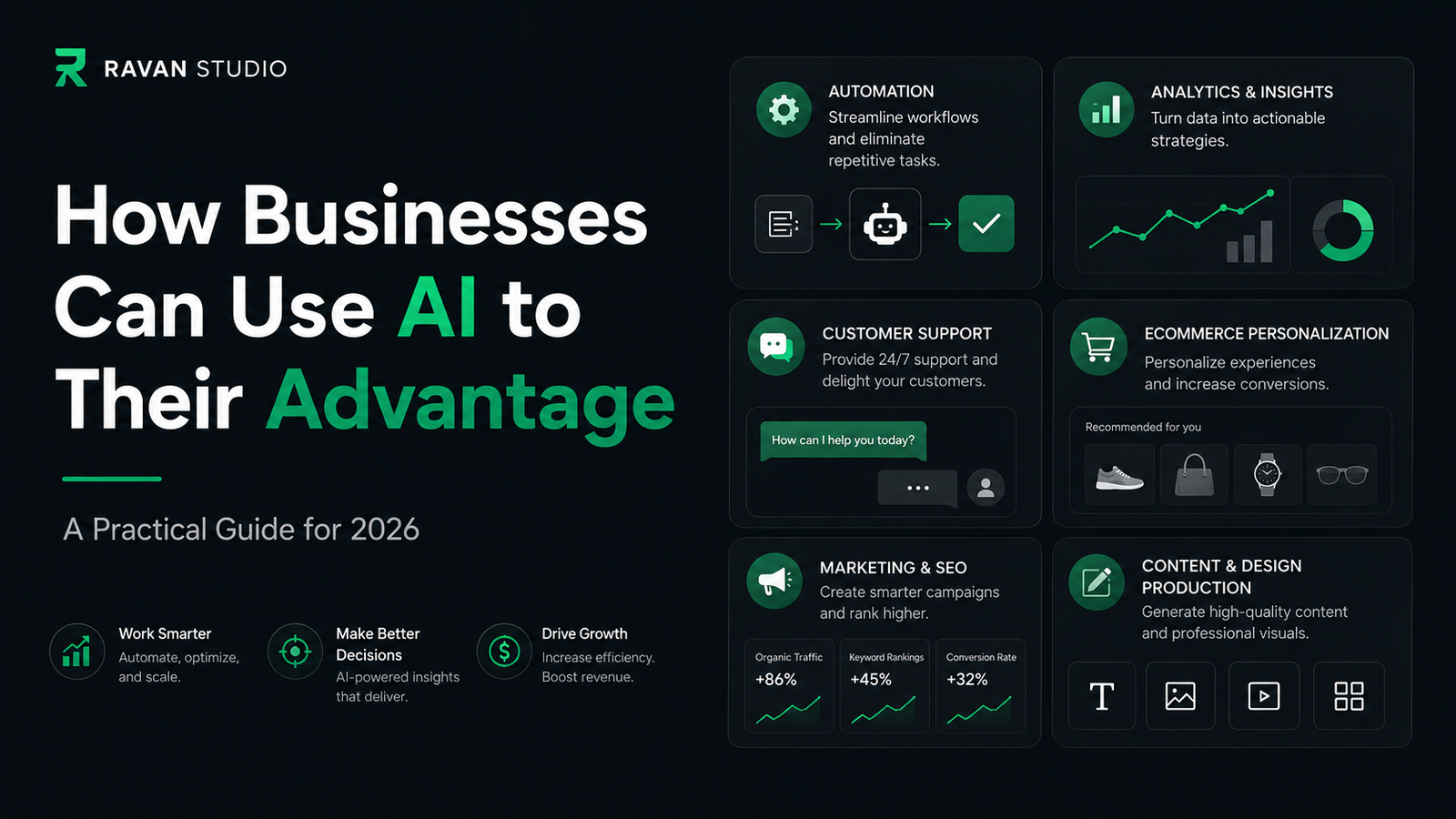
1. Automate the Work That Steals Your Team's Time
The fastest ROI from AI is almost always workflow automation. Think about the repetitive tasks eating hours every week:
• Answering the same 20 customer questions
• Copying data between spreadsheets and platforms
• Drafting routine emails, invoices, and reports
• Categorizing and routing inbound inquiries
AI-powered chatbots and virtual assistants can now handle first-line customer support around the clock, escalating only the complex cases to humans. Internally, intelligent automation connects your CRM, email, and accounting tools so data flows without anyone retyping it.
This usually isn't a “rip everything out” project — it's a smart layer added to the systems you already run. That's exactly the kind of work covered in our website enhancements and integrations service: connecting AI tools to your existing site and stack so they work together instead of in silos.
2. Personalize the Customer Experience (Especially in Ecommerce)
Generic experiences don't convert anymore. AI makes personalization achievable for businesses that don't have Amazon's budget:
• Product recommendations based on browsing and purchase behavior
• Dynamic pricing and promotions tuned to demand
• Abandoned-cart recovery with messaging timed and worded by AI
• Search that understands intent, not just keywords (“warm jacket for hiking” instead of exact product names)
For online stores, this is where AI moves revenue needles fastest. If you're running a store, our ecommerce solutions team builds these capabilities directly into WooCommerce and custom platforms — and our case study on the WooCommerce growth store shows what a conversion-focused build looks like in practice.
3. Make Decisions With Predictive Analytics, Not Gut Feeling
Your business already generates the data — sales history, traffic patterns, customer behavior. AI turns that raw data into forward-looking answers:
• Demand forecasting: know what to stock before the season hits
• Churn prediction: identify at-risk customers while you can still save them
• Lead scoring: focus your sales team on prospects most likely to buy
• Anomaly detection: catch fraud, billing errors, or site issues early
The prerequisite is clean, connected data. A business running on disconnected spreadsheets can't feed an AI model anything useful — which is why data infrastructure is often the real first step. Custom dashboards and data pipelines are core to our web application development work.
4. Use AI in Marketing and SEO — Carefully
AI can supercharge marketing, but it's also where businesses most often hurt themselves. The right way to use it:
• Research and drafting: let AI handle first drafts, keyword clustering, and content outlines — then have humans add expertise, proof, and voice.
• Content optimization: analyze top-ranking pages, identify semantic gaps, and structure content around real search intent.
• Ad optimization: AI-driven bidding and audience targeting in paid channels.
The wrong way: publishing walls of unedited AI text. Google's systems are increasingly good at rewarding experience, expertise, authoritativeness, and trust (E-E-A-T) — and demoting content that adds nothing new.
There's also a bigger shift underway: your customers are increasingly finding businesses through AI search experiences — AI Overviews, chat assistants, and answer engines — not just blue links. Optimizing for that world requires structured data, clear entity relationships, and machine-readable content. We covered this in depth in Designing for the Invisible User: Making Your Website Readable for AI Search Engines, and it's a core pillar of our SEO optimization service. To see the methodology applied end-to-end, have a look at our holistic SEO campaign case study.
5. Speed Up Content and Design Production
Generative AI won't replace your brand's creative direction — but it dramatically compresses production time:
• Rapid concept variations for campaigns and social media
• Image editing, background removal, and asset resizing at scale
• On-brand copy variations for A/B testing
The caveat: AI output is only as good as the brand system guiding it. Without defined colors, typography, voice, and visual rules, AI tools produce generic noise. A strong foundation — the kind we build through our graphic design and brand identity work — is what makes AI-assisted production look intentional instead of automated.
A Realistic AI Adoption Roadmap (Without the Overwhelm)
Here's the sequence we recommend to clients:
1. Audit one bottleneck. Pick the single most expensive repetitive process — usually customer support, content production, or data entry.
2. Start with off-the-shelf tools. Prove value with existing AI products before commissioning anything custom.
3. Connect your data. Integrate your website, CRM, and analytics so AI has something accurate to learn from.
4. Measure ruthlessly. Track hours saved, response times, and conversion rates — outcomes, not outputs.
5. Scale what works. Only after a use case proves itself do you invest in custom AI features or deeper integrations.
And one honest note: AI isn't free — computationally or environmentally. Every model you run consumes real energy, a tension we explored in The Green AI Dilemma: How Energy-Aware Computing Is Saving the Grid. Choosing efficient, right-sized tools isn't just good ethics; it's good economics.
Common Mistakes to Avoid
• Buying tools before defining problems. Subscriptions pile up; nothing changes.
• Feeding AI sensitive data without a policy. Set clear rules on what customer and business data can go into third-party tools.
• Removing humans entirely. AI drafts, humans decide. Especially anywhere accuracy, legality, or brand reputation is on the line.
• Ignoring your website. If your site can't be read by AI search engines, every other AI investment is fighting uphill.
Frequently Asked Questions
Is AI only for big companies?
No — small businesses often see faster returns because their bottlenecks are clearer and off-the-shelf AI tools now cost less than a part-time hire.
How much does it cost to start using AI in a business?
Most businesses can start with existing tools for under a few hundred dollars a month. Custom AI integrations cost more but are only worth it after a use case proves ROI.
Will AI-generated content hurt my SEO?
Not inherently. Search engines penalize unhelpful content, not AI-assisted content. AI-drafted, human-refined content that demonstrates real expertise performs well.
What's the first AI use case most businesses should try?
Customer-facing FAQ automation or internal content drafting — both are low-risk, fast to deploy, and easy to measure.
Ready to Put AI to Work — Strategically?
The winners of the AI era won't be the businesses with the most tools. They'll be the ones who applied the right intelligence to the right problems, on top of a website and data foundation built to support it.
If you want a partner who thinks in outcomes, not outputs, get in touch with Ravan Studio — or explore our full range of services to see where AI-ready foundations fit into your growth plan.